Solving Data Fragmentation in Asset Management: The Omni Challenge
If it feels like asset management distribution gets harder every year, that’s because it does. Growing assets has become more difficult, time-consuming, and expensive. As top advisors narrow who they work with and shift more decisions into models and managed accounts, the traditional distribution playbook is being pushed to its breaking point.
Sales cycles can stretch from one to three years, and more than half of asset managers cite distribution and asset gathering as their biggest challenges in today’s competitive market (Morningstar, 2025). At the same time, data has become more expensive and harder to differentiate—making timely, actionable intelligence the real constraint on growth.
Firms are investing heavily in technology, data, and services, yet many tech stacks still feel slow, rigid, and unable to deliver impact at the speed the market demands.
These aren’t isolated symptoms. They’re the result of a structural shift in how products are sold and supported. A shift the industry hasn’t yet fully addressed.
And while expectations for performance have increased, the need for faster time to value, shorter onboarding cycles, and lower ongoing operating costs have never been greater. Distribution teams need insights immediately, not after years of data integration work. The challenge is that most legacy environments were never designed to deliver that kind of speed.
What Is the Omni Challenge?
Most asset managers are now operating in what Synfinii calls the Omni reality.
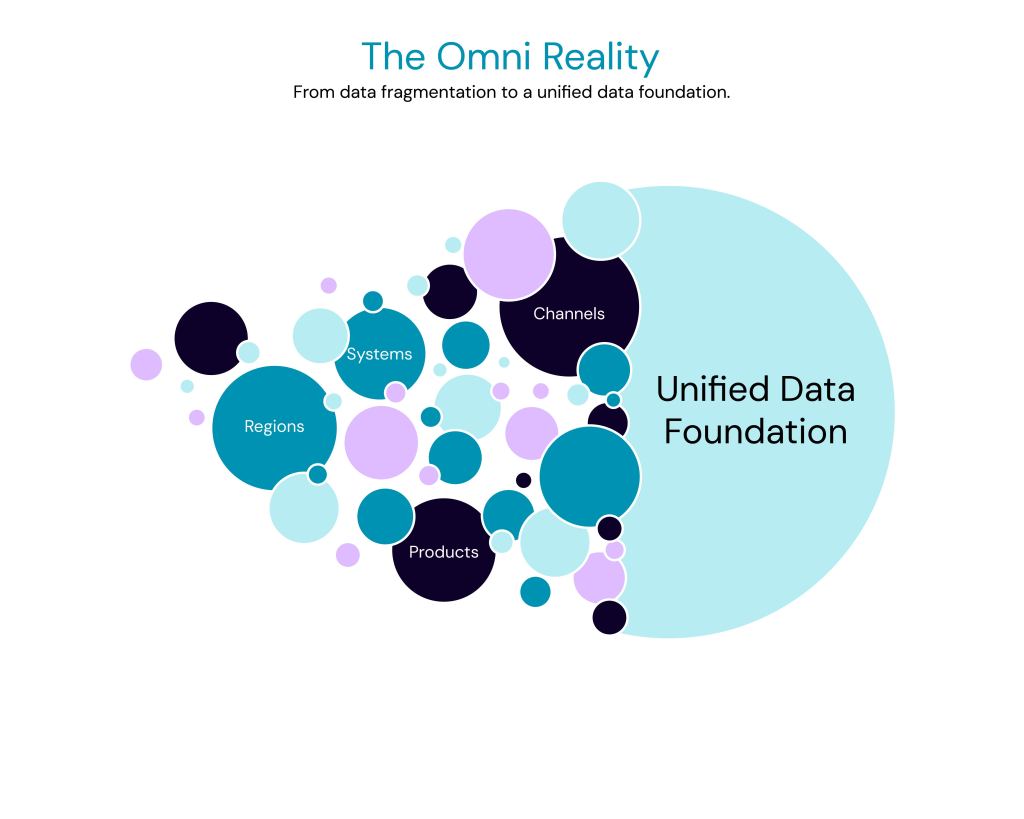
It’s a world defined by more channels to manage, more regions to support, more products to track, and systems that were never designed to keep up with that level of complexity. Over time, firms have added new tools, data sources, and processes to respond to growth and client demands. But those additions were rarely built to work together.
The result is data fragmentation: an environment where distribution workflows are stitched together manually, and every new business decision adds friction instead of momentum.
That friction shows up in very real ways:
- Onboarding timelines measured in quarters instead of weeks
- Expensive custom integrations that must be rebuilt whenever the business evolves
- Insights that arrive too late to influence decisions
- AI initiatives that struggle to deliver meaningful value
This tech and operational debt accumulated gradually as firms expanded into new channels and markets, launched new vehicles (like ETFs, SMAs, CITs, and interval funds), and adapted to evolving regulations. Each move made sense in the moment. Collectively, they created an environment where complexity compounded faster than capability.
This is the Omni Challenge: the widening gap between how modern distribution must operate and what most technology, data, and service models were originally built to support.
Breaking through that challenge doesn’t require more point solutions. It requires a new operating foundation—one designed to scale, adapt, and coordinate across services, data, and technology as the business evolves.
The AI Inflection Point
The current push toward Artificial Intelligence has made the Omni Challenge even more visible. On the surface, AI promises to be the ultimate solution for distribution efficiency—automating insights and personalizing outreach at scale.
However, for many firms, the results have been frustrating. Industry research continues to highlight a paradox of rising investment and elusive returns, with siloed platforms and fragmented data as the primary barriers to success (Deloitte, 2025).
The reality is simple: AI is only as powerful as the data foundation beneath it.
When data is fragmented across disconnected systems, AI cannot deliver on its promise. Instead of a silver bullet, firms end up with expensive tools that produce incomplete or unreliable results—because the underlying data foundation is broken.
You cannot automate what you haven’t first unified.
Why Incremental Fixes Fail
For over a decade, asset managers have tried to solve these issues by adding point solutions—new CRM layers, data feeds, or third-party platforms and service providers. While each investment makes sense in isolation, none of them change the underlying structure required to win in a modern market.
This has left many distribution organizations with:
- Disconnected systems that require constant manual reconciliation
- Multiple versions of the truth across products, clients, and accounts
- AI and automation initiatives that underperform due to inconsistent data
- Long, expensive integrations that delay business impact
- Outsourced services that struggle to deliver measurable ROI
The challenge isn’t effort.
The challenge is structure.
And structure determines speed.
When foundational data is fragmented, onboarding takes too long, insights arrive too slowly, and costs inevitably rise.
How Asset Managers Are Solving Data Fragmentation
Synfinii was built to address this structural gap—not by adding another layer of technology, but by rethinking the data foundation itself.
By leveraging a cloud-native architecture paired with industry-native expertise, we’ve helped firms move away from rigid legacy workflows toward a unified platform designed specifically for the complexities of modern distribution.
This approach allows firms to move past the friction of the Omni Challenge and adopt a model built for rapid time to value:
- Implementations measured in weeks, not years
- Onboarding that delivers usable insights immediately
- Flexibility to support new products, channels, and regions without expensive rework
- AI and analytics that finally function as intended
- Lower long-term cost of ownership
The result is not just better intelligence—but a platform that continuously drives additional value as the business evolves.
When data fragmentation is removed, everything speeds up. Distribution teams gain faster access to actionable intelligence. New initiatives can be launched without rebuilding the tech stack. And ongoing operating costs decline as firms replace layers of point solutions with a single, coherent operating foundation.
Proven Results in the Real World
I’ve shared what we’re seeing across the industry, but you don’t have to take my word for it. Our clients are proving what’s possible when you tackle the Omni Challenge with the right strategy and the right foundation.
Asset managers using Synfinii are:
- Accelerating onboarding timelines
- Reducing manual reconciliation work
- Enabling AI and analytics that deliver real ROI
- Lowering service costs
- Giving distribution teams faster, more reliable insights
These stories all point to the same truth:
When firms unify their data foundation, they unlock speed, clarity, and growth that weren’t possible before.
Solving the Omni Challenge, One Problem at a Time
This post serves as the foundation for an ongoing series focused on the real-world friction points that continue to slow modern asset management distribution.
We’ll start with Data with Direction: Architecting a Master Record for AI Readiness—an exploration of how fragmented data quietly undermines speed, trust, and decision-making, and what it takes to turn disconnected systems into a unified, working engine.
From there, future posts will build on this foundation, diving into the structural challenges that surface once data is connected—how insights are activated, how complexity is managed, and how firms move from simply seeing their data to actually using it.
Each installment will break down the why behind these persistent roadblocks and show how a modern data architecture can turn friction into forward momentum.
A Strategic Opportunity
The Omni Challenge isn’t just a technical hurdle—it’s a strategic constraint on growth.
But for firms that get the foundation right, the reward is significant:
- Faster onboarding
- Quicker time to revenue impact
- Lower ongoing costs
- A platform flexible enough to power future innovation
That combination creates a massive competitive advantage in an increasingly complex market.
I’m looking forward to sharing these solutions over the coming months. In the meantime, I’d love to hear which of these distribution hurdles is hitting your desk most frequently right now, and where you’re feeling the most friction. Let’s connect on LinkedIn and keep the conversation going.
Follow this series as it unfolds.
Subscribe to Synfinii Insights and you’ll receive each post as it’s published—starting with From Data Chaos to Clarity—and see how firms are systematically solving the Omni Challenge.

About Synfinii
Synfinii partners with asset managers worldwide to enable data-driven distribution by mastering data, integrating intelligence, and building solutions that help achieve your business objectives. Excellence in client service, deep industry knowledge, technical strength, and extraordinary teamwork have defined us for over 40 years.
Synfinii—our brand since September 2025—was previously known as SalesPage.