One Client, Many Roles: How Unified Profiles Reveal Total Relationship Value
During my Ph.D. research, I spent years studying different ways to analyze or visualize structures that are too complex to draw on a page. One lesson stood out: complexity isn’t the enemy—fragmentation is.
Making order and sense out of complex and noisy data has been a throughline from my academic work to my engineering work at Synfinii. And nowhere is fragmentation more damaging than in understanding a client’s Total Relationship Value.
The Challenge: One Person, Four Roles—and Zero Cohesion
A single financial advisor often wears multiple hats across different platforms, firms, or business lines. In most distribution ecosystems, that advisor becomes four separate records—each disconnected, each incomplete.
These disconnected identities splinter what should be a unified understanding of the client.
Take a hypothetical multi-role investment professional, Robert Wallstreet, as an example: he is one person, but in a fragmented ecosystem, he becomes four separate records with no connection between them:
- A Financial Advisor at Morgan Stanley, serving retail clients
- An Institutional Consultant at Graystone Consulting, advising pension funds
- A Managing Director in Account Support and Operations
- A direct personal investor in his own right
Without a unified view, no single team sees the whole relationship. The retail team works from their slice. The institutional team works from theirs. Neither knows what the other is seeing—or missing. And the client, receiving uncoordinated outreach from teams that don’t know they share a relationship, experiences exactly that fragmentation firsthand.
This is fundamentally a client data management problem. When identities fragment across systems, the relationship itself becomes fragmented as well—and that fragmentation has real costs for your firm and a real impact on your clients.
The Implications: Missed Value Hidden in Plain Sight
As the volume and velocity of data continue to grow, fragmented identities multiply right along with it. Without cohesion, firms lose the ability to understand or calculate the Total Relationship Value of a person or entity.
This means:
Revenue is systematically underestimated. When Robert’s institutional book and his retail production are tracked as separate, unrelated records, no one can see the full relationship. His total value to the firm—across channels, roles, and assets—never appears in a single view. The advisor who looks like a mid-tier retail producer is actually one of your most significant institutional relationships. You won’t know until it’s too late to act on it.
Segmentation and targeting misfire. When the entity behind those roles is invisible, data-driven models score the wrong persona. Marketing campaigns reach the wrong version of the client. Distribution prioritization gets the tier wrong. Outreach is timed poorly, or duplicated across teams who don’t know they’re calling the same person—creating an experience that signals to your client that your firm doesn’t actually know them.
Compliance walls become impossible to enforce with precision. Retail teams are legally restricted from seeing institutional data, and vice versa. When Robert’s roles aren’t properly separated into governed profiles, you’re either over-sharing—creating regulatory exposure—or over-restricting, cutting teams off from information they need. Without structure, you’re managing compliance by hope rather than by design.
It’s the same pattern described in the Master Record for Asset Managers post: data fragments compound into operational and strategic blind spots. And as highlighted in the Omni Challenge perspective, fragmentation across systems doesn’t just slow teams down—it distorts how firms perceive opportunity itself.
The result is incomplete visibility for your teams and a disjointed servicing experience for your clients.
How Synfinii Solves It: Profile-Based Relationship Intelligence
Synfinii approaches client understanding the same way we approach master records: not by forcing data sources to “agree,” but by synthesizing them into a single governed profile.
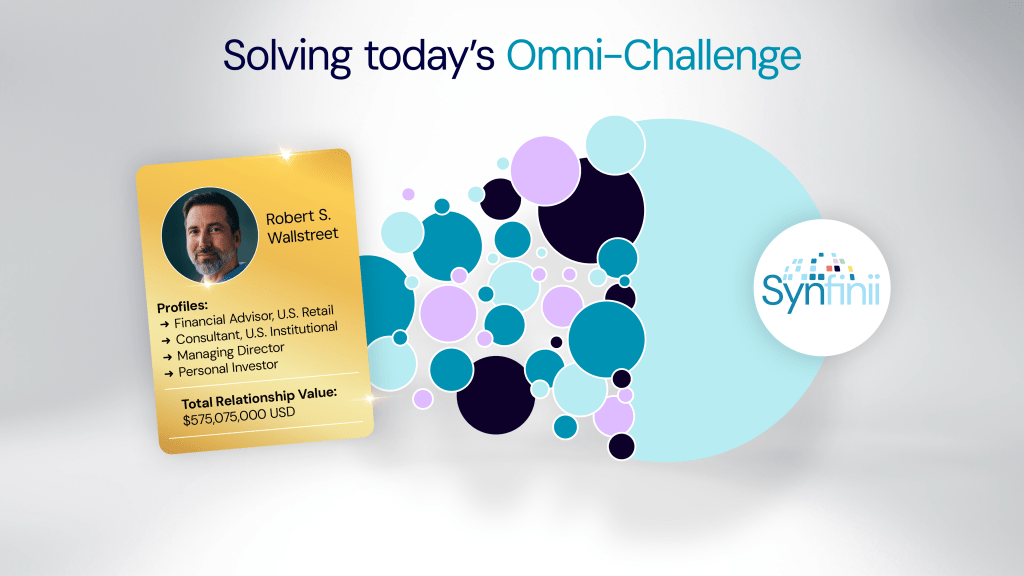
Synfinii’s Client Profiles unify those four roles—advisor, consultant, supervisor, and channel—into a single Client that preserves their individuality while connecting them through one authoritative identity. This resolves duplicates and consolidates previously disconnected records into one governed profile, which provides a more complete view of the client.
In practice, this means:
- All roles map to one client profile.
- All activities, assets, and interactions roll up accurately — or can be curated so specific teams see only the profile view relevant to their channel.
- Teams can finally quantify the client’s total relationship value, not just fragments of it.
- And because this architecture aligns with the governed master‑record philosophy, distribution teams benefit from consistent logic across attribution, identity, governance, and data activation.
In short, the full client relationship finally comes into focus.
The Outcomes: Total Relationship Value, Realized
1. Complete, role-aware visibility
Teams see every capacity (or only the ones relevant to their channel) in which a person or entity participates—producer, advisor, supervisor, office lead—enabling richer segmentation and more accurate reporting.
2. Accurate relationship valuation and influence mapping
With all touchpoints consolidated, firms can quantify influence, production, network reach, and decision‑making power with precision across all channels.
3. AI‑ready client data
Unified profiles give AI models the coherent, accurate structure they depend on—making downstream insights more reliable, more actionable, and more explainable.
Reframing Client Data Management Through a New Lens
Moving from mathematical abstractions to data architecture didn’t change the core challenge I love solving: making complex systems make sense.
Total Relationship Value isn’t a metric, it’s a lens—a practical way to see and understand how all parts of a client relationship fit together.
Unified profiles give firms the clarity they need to see clients as they truly are: whole, interconnected, and full of untapped potential.
Curious where fragmented identities may be costing you?
Request a guided walk‑through of Synfinii Client Profiles.

About Synfinii
Synfinii partners with asset managers worldwide to enable data-driven distribution by mastering data, integrating intelligence, and building solutions that help achieve your business objectives. Excellence in client service, deep industry knowledge, technical strength, and extraordinary teamwork have defined us for over 40 years.
Synfinii—our brand since September 2025—was previously known as SalesPage.