Your System Says One Owner. Your Business Says Otherwise. Solving Attribution Across Distribution.
I’ve spent a lot of time in this industry looking at data problems. And the ones that frustrate me the most aren’t the complex technical failures. They’re the simple structural mismatches that should have been solved years ago.
Here’s one I see constantly: an advisor team co-manages a book of business. Two reps, shared coverage, agreed-upon credit splits. But when it’s time to report on that account or calculate compensation, the system only knows one person. So, someone pulls out a spreadsheet and starts reconciling.
Prefer the 3-minute version? Watch this explainer to see the real impact on your business.
The same problem shows up in institutional distribution, which we covered in an earlier post: pension funds, consultants, custodians, where a single mandate can involve multiple parties, each with a legitimate claim to credit, and most systems have no clean way to represent that.
These aren’t edge cases. They are the everyday reality of distribution. And they’re exactly the kind of problems that Multiple Account-Client Attribution, a key feature of the Synfinii distribution data platform, was built to solve. In this post, I’ll walk through an intermediary scenario I see often: shared advisory coverage.
The Problem with Single-Owner Models in Intermediary Distribution
The intermediary channel is built on relationships, and relationships in this channel aren’t always one-to-one. Think about how your teams operate:
- An advisory team at a wirehouse co-manages a major client household. Two advisors share the relationship, split the book, and expect compensation to reflect that reality.
- A regional distributor works with a broker-dealer office where multiple contacts share a book and rotate coverage. Crediting one person misses the story.
Most legacy systems weren’t built to handle this. They were built around a primary contact field. And when reality is more complicated than that field can hold, workarounds appear: spreadsheets on someone’s desktop, manual splits calculated outside the CRM, compensation disputes that get resolved on a call rather than in the data.
I’ve seen ops teams spending real hours every month just bridging the gap between what the system says and what actually happened. That’s time that could go toward analysis, client support, or literally anything else.
Shared Coverage in Advisory Teams
Consider a common scenario for an asset management distribution team: a high-value account, like the Johnson Family Trust, is managed by an advisory team whose footprint spans multiple geographic boundaries. The distribution team determines that credit for this account should be split 60/40 between two distinct sales territories.
In a legacy, single-owner system, you are forced to assign the account to just one territory or salesperson. This instantly creates an operational hurdle for the distribution team. Either wholesaler compensation is inaccurate, the sales operations team is forced to manually adjust production downstream, or you are maintaining a separate tracking spreadsheet that is always one refresh behind.
The Solution: Multiple Account-Client Attribution
With Multiple Account-Client Attribution, sales operations can seamlessly link multiple territories and sales roles to a single account. For the Johnson Family Trust, credit is cleanly divided—60% to Territory A and 40% to Territory B—totaling 100% within that distribution role.
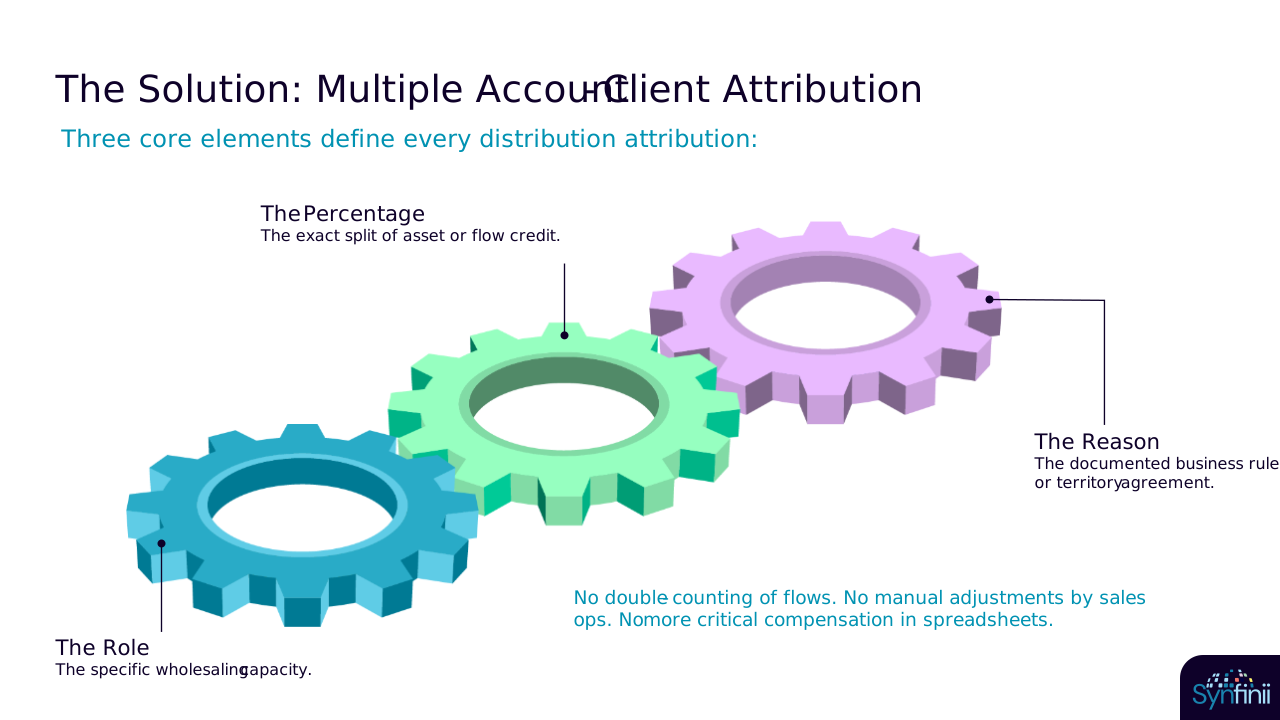
Three core elements define every distribution attribution:
- The Role: The specific wholesaling capacity (e.g., External Wholesaler, Internal Wholesaler, Key Accounts).
- The Percentage: The exact split of asset or flow credit.
- The Reason: The documented business rule or territory agreement, establishing a reliable audit trail for compensation.
The Result: When running firm-level distribution or product reporting, the account’s assets and flows count exactly once. When running territory-level dashboards, each sales team sees their precise, pro-rated share.
The Bottom Line: No double-counting of flows. No manual adjustments by sales ops. No critical compensation spreadsheets marooned on a laptop while a data analyst is on vacation.
This is how advisory teams actually work: shared territories, split credit, real complexity. Most platforms have just been slow to reflect that reality. Synfinii doesn’t require you to simplify the business to fit the system.
Why Asset Managers Choose Synfinii for Attribution
Modeling attribution correctly is only part of the challenge. The other part is implementing it without creating another layer of operational complexity.
That’s where Synfinii is different. The platform connects to your existing data sources, encodes your business rules directly into the data model, and provides built-in validation to maintain data quality over time. Every attribution record includes documented business rationale and a complete audit trail, supporting compensation reviews, governance requirements, and regulatory reporting.
The result isn’t just more accurate attribution. It’s fewer manual processes, faster implementation, and a system that scales as your distribution model evolves.
Most importantly, compensation disputes get resolved by looking at the data—not by getting everyone on a call.
One Piece of a Larger Challenge
Account attribution is one piece of a larger challenge. As asset managers navigate the pressure of managing more products, more channels, and more relationship types than legacy systems were built to handle, the gaps in distribution data infrastructure become harder to ignore.
The attribution problem shows up differently depending on where you sit. In intermediary distribution, it’s shared advisory coverage that the system can’t split: two contacts, one account, and a spreadsheet that should never have existed. In institutional distribution, it’s the consultant relationship that influenced a $200M mandate going untracked because the platform only has room for one owner. Different symptoms, same root cause: a data model that wasn’t built for the complexity of modern distribution.
The firms I see getting ahead of this aren’t waiting for a complete platform overhaul. They’re solving one problem at a time, starting where data inaccuracy has the most direct impact on compensation and reporting. For most teams, attribution is exactly that place.
When relationships are modeled correctly, everything downstream improves. Insights come faster. Reports mean something. And the clean data foundation you build here is what makes analytics, smarter segmentation, and better distribution decisions possible.
Bring Us Your Hardest Attribution Problem
If attribution is creating friction in your distribution operations—whether in shared coverage teams or institutional complexity—we’d welcome the chance to walk through what’s possible for your specific situation. Every firm’s relationship structures are a little different, and that’s exactly the kind of thing we like to dig into.

About Synfinii
Synfinii partners with asset managers worldwide to enable data-driven distribution by mastering data, integrating intelligence, and building solutions that help achieve your business objectives. Excellence in client service, deep industry knowledge, technical strength, and extraordinary teamwork have defined us for over 40 years.
Synfinii—our brand since September 2025—was previously known as SalesPage.