When Your Source of Truth for AI is a Person
In most firms, distribution data works because one very good analyst makes it work. That is a real advantage, and AI has just moved up the date it stops being enough.
Most firms in this industry have one. The analyst who knows which file to trust in March. Sometimes it is the head of sales operations. Sometimes it is a founder who never fully handed the work off. Whoever it is, they keep the exception list in their head and they catch the number that looks wrong before it reaches a board deck.
That person is not a workaround. They are a real, working deterministic system: the same question gets the same answer every time, because one human is holding the definitions together. With a focused product set and a tight team, it is often genuinely sufficient.
Until it isn’t. And the two ways it stops being sufficient are worth naming separately, because they are different problems.
The Definition Walks Out the Door
The first cost is risk. The definition lives in a person, and people take vacations and people take other jobs. When they go, the loss isn’t throughput. It is the definition itself, because nobody ever wrote it down. What “advisor” means, what counts as a client, where the Northeast starts and stops: all of it leaves with them.
The second cost is a ceiling, and it arrives more quietly. Adding a channel doesn’t add proportional work, it adds combinations. Every new source has to be reconciled against every source already in place. Launch ETFs and the transfer agent report stops lining up with the CRM. Add model-delivery SMAs and the numbers come from platforms that were never built to agree with each other. The work escalates faster than headcount can, and at some point hiring stops being the answer. Things don’t stop getting done. They get done later, with less checking.
One Dependency, Three Different Symptoms
What makes this hard to see is that nobody experiences it the same way.
The head of distribution feels it as broken trust. A sales team is finally firing on all cylinders and turnover is the last thing anyone wants. Then one rep sees one number that is wrong, and the trust is gone. Once a sales team stops believing the data, they stop using it, and they stop saying so. Meanwhile the newest products, the models launched last year and the ETFs added this summer, never made it into the CRM at all. The team is selling what it can see and guessing at the rest.
The national sales manager feels it as flows that got away. The job is money in, money out, and net new advisors. But the model book is nearly impossible to see across wirehouses, smaller intermediary relationships disappear into omnibus, and by the time attribution catches up the picture belongs to last cycle. Decisions that should take hours take a reporting cycle.
The analyst feels it as reconciliation that never ends. One person against half a million trades a year, with distribution data scattered across a transfer agent and several platform feeds. Rep lists dry up and go stale. Every new partner is another source to align by hand. They know exactly which file to trust in March, and they also know that knowledge lives nowhere but in their own head.
Same dependency, three symptoms, and no shared vocabulary between the three people describing it.
Why This Matters More Than It Did Two Years Ago
None of the above is new. Firms have run this way for decades and the analyst has always been the thing that made it work.
What changed is what now sits on top. Every AI capability being sold into distribution, from next best action to propensity scoring to territory optimization to conversational reporting, consumes that foundation directly, and consumes it invisibly. A wrong dashboard looks wrong. A wrong answer in fluent, confident language looks right.
The judgment the analyst applied at the end of every report was doing more work than anyone accounted for. It was the error correction layer. Point AI at the same sources and far more decisions run through them, faster, with nobody in the middle catching the ones that don’t make sense.
AI does not remove the need for that judgment. It removes the opportunity to apply it.
Knowing Which Side of the Line a Firm is On
None of this argues for buying something. A spreadsheet with clear formulas and clear instructions is a legitimately deterministic system, and for plenty of firms it remains the right one.
The trigger for moving isn’t AUM and it isn’t headcount. It is the first time the same thing has to mean the same thing in two places that don’t share an owner. Before that point, documentation and process are the right investment, and writing down what the analyst knows is worth more than any platform. After it, discipline alone stops being enough.
The harder question is how to tell which side of that line a firm is currently on, and that turns out to be answerable in an afternoon. There are three specific tests, they need no budget and no vendor, and most firms fail the second one without knowing it.
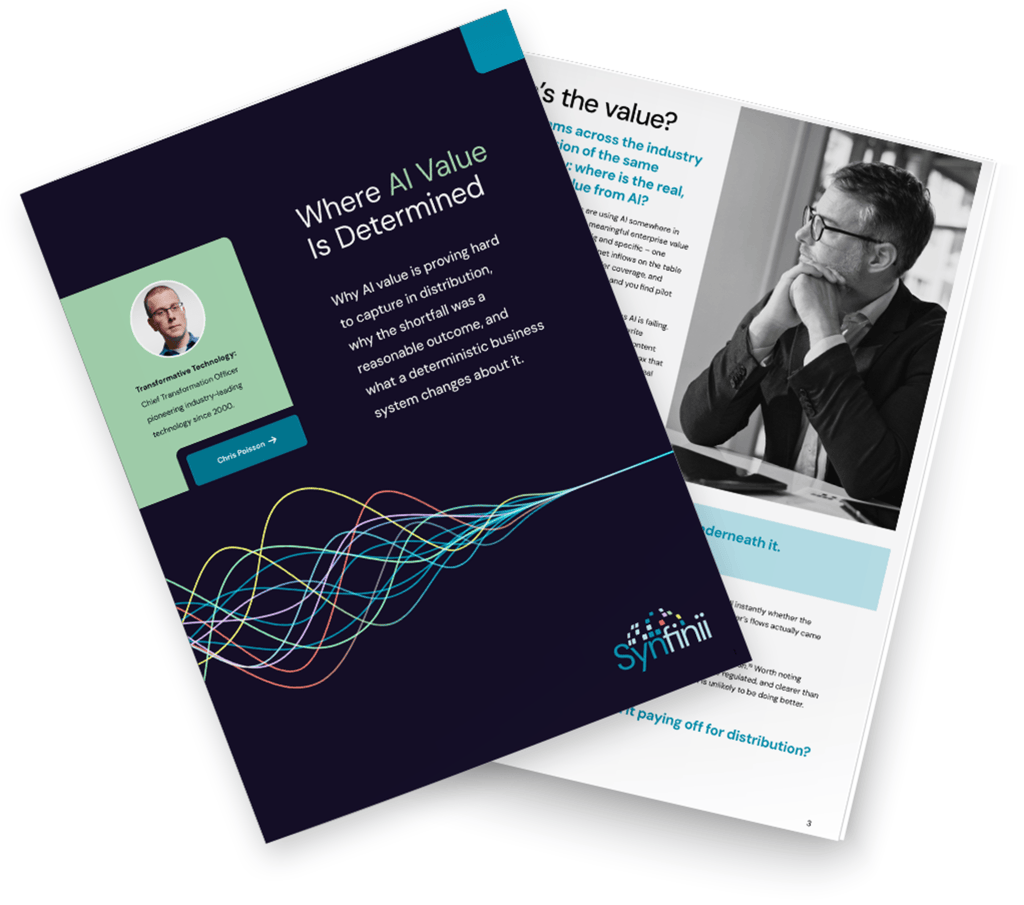
Those tests, along with why AI value is proving so hard to capture in distribution and what changes when a system rather than a person holds the definitions together, are set out in the white paper Where AI Value Is Determined.
Worth reading. Also worth handing to the analyst who has been holding it all together. They will recognize every word.
Start with the foundation.
This is one symptom of a bigger shift in distribution data. The full case for why AI value is so hard to capture in distribution, and what changes it, is where the series begins.

About Synfinii
Synfinii partners with asset managers worldwide to enable data-driven distribution by mastering data, integrating intelligence, and building solutions that help achieve your business objectives. Excellence in client service, deep industry knowledge, technical strength, and extraordinary teamwork have defined us for over 40 years.
Synfinii—our brand since September 2025—was previously known as SalesPage.